My relationship with bees, and dare I say, my obsession with the esoteric tradition of venerating and emulating their magical ways, began nearly two decades ago, when I started my studies with a German Cabbalist living in Catalonia. Her name was Ingrid, and among those she had mentored were none other than Salvador Dalí and Jean Cocteau. Like many of life’s most fateful encounters, we were never supposed to meet. Yet when we did, she immediately invited me to study with her.
On that first unforgettable morning, bees circled our breakfast table on her sunlit patio. Our carefully planned study agenda was quickly abandoned, and instead we began discussing bees, their symbolism, their mysteries, and the strange reverence they had inspired across cultures and centuries. That single conversation became the foundation of a study that would continue for several years.
During the course of our intensive work together, I became particularly fascinated by beehive-shaped huts and ancient structures that echoed the geometry of the hive itself. I set out to visit and study them, travelling through France, Spain, Turkey, South African Zulu villages, Mesoamerica, Mesopotamia, and beyond; drawn to these curious and ancient forms wherever they appeared.
Yet there was one ancient site I had never visited: what academia claimed were the oldest beehive huts in the world, the 5,000-year-old Jebel Hafeet Beehive “Tombs” in the UAE desert, near the border with Oman.
A business trip to Abu Dhabi finally gave me the opportunity I had been waiting for. I hired a driver and ventured two hours into the desert, and after a series of misguided detours, I eventually found myself standing before these peculiar structures in the shadow of the steeply rising 1,160-metre Jebel Hafeet mountain. Hundreds of these so-called tombs have been discovered in the area, with artefacts suggesting trade links to ancient Mesopotamia.

Approaching Jebel Hafeet
There was only one problem. The beehive huts did not appear to be tombs at all.
Each structure shared the same southwesterly orientation, too deliberate to dismiss as coincidence. More striking still, the highest concentration of them lay at the base of what looked unmistakably like a man-made façade cut into the mountain itself—a mountain that geologists have found to be riddled with tunnels and chambers.
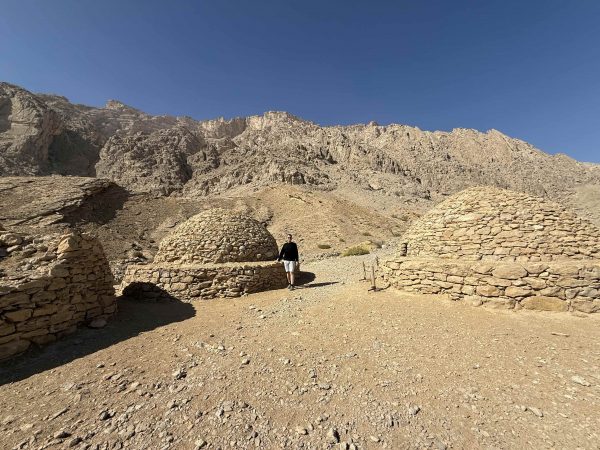
At the base of Jebel Hafeet
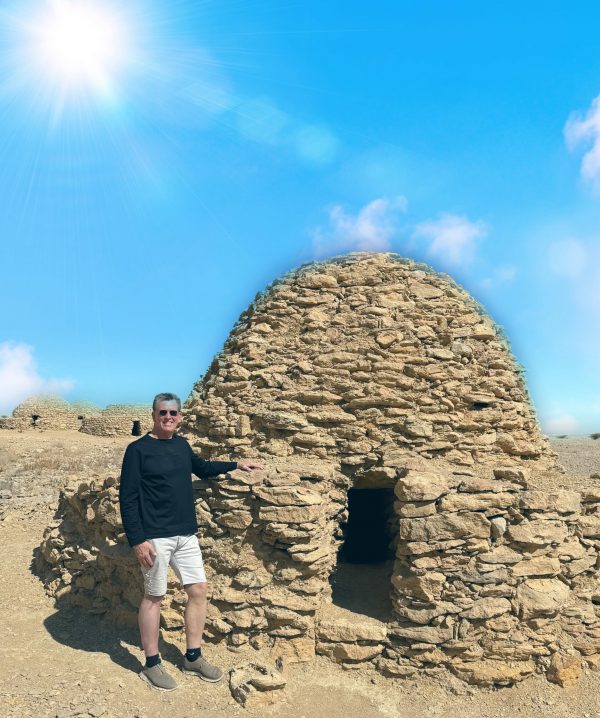
Next to one of the ancient Beehive structures
The more I stood there, the less convinced I became that I was looking at a necropolis. Instead, it seemed far more likely that these were the remains of a civilisation that had once thrived in this region in deep antiquity—one whose purpose, beliefs, and knowledge have long since been buried beneath the sands.
Who they were, and what exactly they were doing there, remains a mystery I continue to investigate.
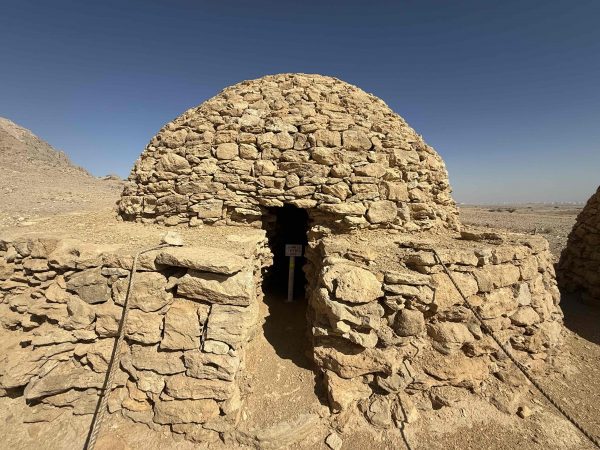
Tomb, or something else entirely?

